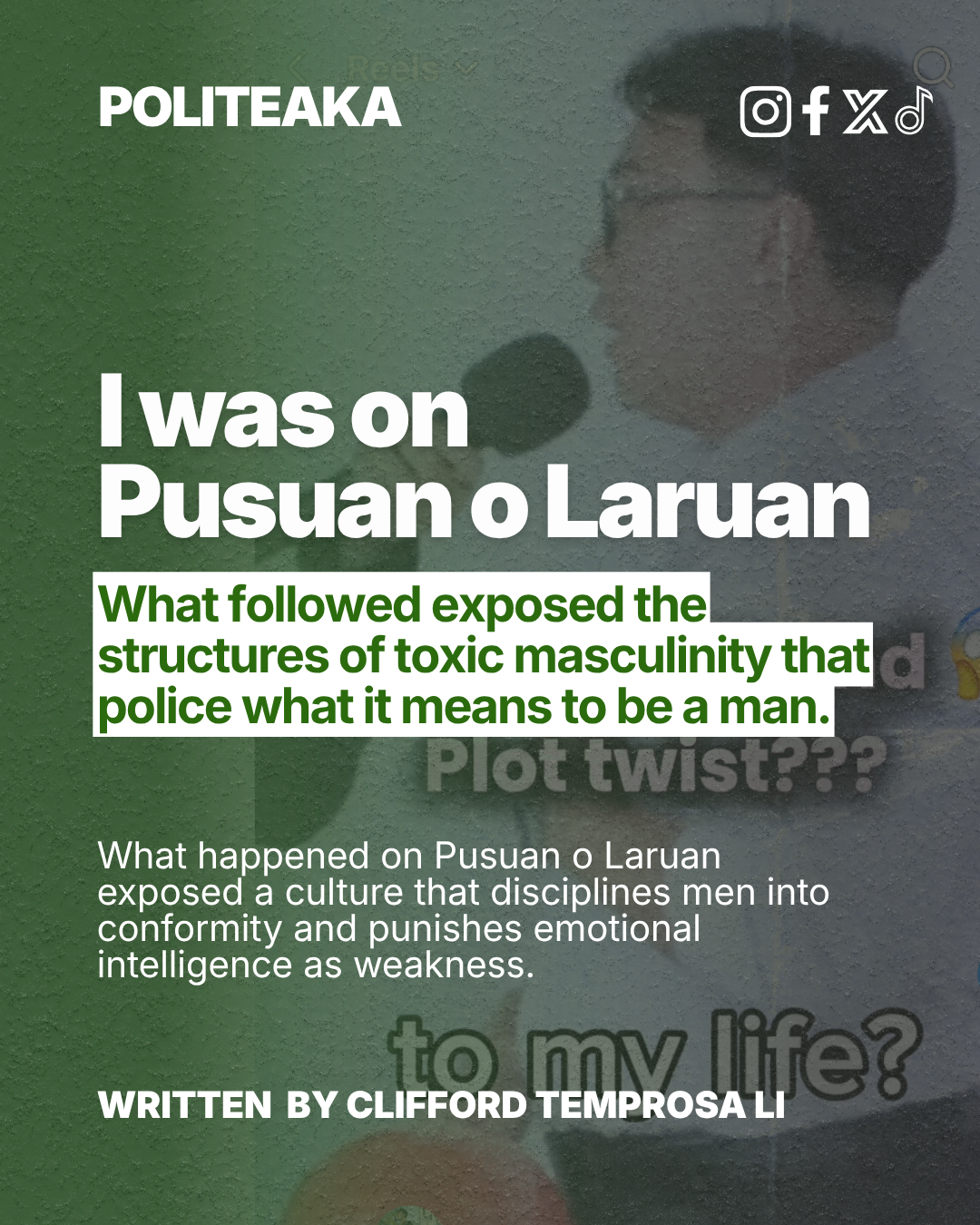
I went to Pusuan o Laruan. What Happened After Says More About Filipino Masculinity Than It Does About Me
A GOOD EXPERIENCE AND WHAT FOLLOWED
I had a genuinely great time in Pusuan or Laruan. The show was respectful, engaging, and thoughtfully produced. The conversations were intentional, and the people I interacted with brought sincerity into the space. Many of us even became friends after the show. The host - Marion Aunor was graceful and kind in an otherwise, at times, awkward environment for participants.
At one point, I asked a question that, to me, felt grounded and direct: What value can you bring to my life?
It wasnΓÇÖt meant to be confrontational. It was meant to be intentional. A question about alignment. About clarity. About what it means to build something real with another person.
The woman I was speaking to was beautiful - wearing a striking red dress, confident, and composed. She carried herself in a way that many would immediately find desirable.
And yet, what seemed to stand out in the reaction online was not the question itself but the fact that I did not immediately conform to what was expected of me at that moment. There was an unspoken assumption: That a man, presented with a woman who looked a certain way, should respond in a certain way.
And when that expectation isnΓÇÖt met - when attraction is approached with intention instead of impulse - it is interpreted not as discernment, but as deficiency. As if choosing clarity over performance somehow makes one less of a man.
But what lingered after the episode aired was not the show itself. It was the comment section. Within minutes of a video being posted, the responses followed a familiar script. Comments such as:
ΓÇ£Parang bakla. Too soft for a guy. Hindi lalaki magsalita. Mukhang hindi tunay na lalaki.ΓÇ¥
And as the thread grew, the critiques became more specific and almost forensic in nature: “Sobrang eloquent…hindi lalaki. Naka-tuck in pa… parang hindi astang lalaki. Ang lambot magsalita.Yung accent… halatang bakla. English magsalita, hindi lalaki.”
What became clear, very quickly, was not just the content of the comments but the pattern behind them. Most of these criticisms were coming from men.
TOXIC MASCULINITY AS A SYSTEM OF CONTROL
This is not unusual. It is, in fact, deeply reflective of how masculinity continues to function in much of Filipino society - not just as an identity, but as a system of performance and enforcement.
This is not just culture but structure. A system that defines what a man should be, and disciplines those who fall outside of it. Masculinity, in this context, is not simply expressed - it is constantly evaluated, measured, and corrected. Not only by society at large but by men themselves.
There are unspoken rules that govern it: Be confident, but not reflective. Be assertive, but not gentle. Be expressive, but not too articulate. Be present, but not emotionally aware.
And increasingly: Speak but not in a way that feels unfamiliar. Dress but not in a way that feels ΓÇ£too intentional.ΓÇ¥ Carry yourself but within a narrow, recognizable range.
Because once a man steps outside of these expectations, something shifts. His masculinity is no longer assumed. It is questioned. And often, it is questioned through a single word: bading or bakla. This version of masculinity is not accidental - it is reinforced through media, upbringing, peer culture, and even colonial and class-influenced ideas of what a ΓÇ£proper manΓÇ¥ should look and sound like.
This is what we call toxic masculinity.
WHEN EVERY DETAIL BECOMES A TEST
What is striking is not just that emotional awareness was interpreted as weakness, but that even neutral characteristics - eloquence, tone, clothing, accent - were enough to trigger suspicion.
A tucked-in shirt became a signal. Articulate speech became a liability. An English-speaking cadence became a marker of ΓÇ£difference.ΓÇ¥ At that point, masculinity is no longer about values or character.
It becomes about conformity. When masculinity is policed this tightly, it stops being identity and becomes surveillance. A way of regulating how men speak, feel, and exist within acceptable boundaries.
In this system, men are not taught how to grow, only how to avoid being seen as something else. And perhaps most tellingly, it does so collectively. Men are not only shaped by these expectations - they are tasked with upholding them. The comment section becomes less of a reaction and more of a mechanism. A way of reinforcing what is acceptable, and correcting what is not. It is no longer about who you are - it is about how closely you resemble what is expected.
MEN POLICING MEN
The fact that most of the criticism came from men is not incidental. It is central to the problem. Masculinity, in many contexts, is not internally defined - it is externally validated, and often enforced by other men. The system is sustained by constant participation.
This creates a culture where men are constantly assessing each other:
* How he speaks
* How he dresses
* How he expresses
* How he carries himself
And when someone falls outside the expected norm, the response is not curiosity. It is a correction. Masculinity becomes less about who you are, and more about what you are trying not to be. Over time, this turns masculinity into something that must be performed consistently, or risk being revoked.
THE POLITICAL COST OF A NARROW DEFINITION
This version of masculinity does more than shape perception - it shapes behavior.
Men begin to self-edit. They adjust how they speak. They soften how they express. They limit how they present themselves. They avoid growth if it risks being misunderstood.
When being a man is defined by what you must not become, you are never free to become anything at all. Over time, this produces a version of masculinity that is not grounded in confidence, but in caution. It becomes fragile. Because if something as small as tone, language, or clothing can call your identity into question, then that identity is not stable. It is conditional.
And when masculinity is conditional, it requires constant defense. Through projection and control. And when emotional intelligence is absent at scale, it does not stay personal - it becomes political.
Think of our politicians, senators, congress members, mayors, councilors, barangay captains. Every position of power. It shows up in the way leaders speak. In the way they respond to criticism. In their inability to listen without reacting. In their tendency to dominate conversations instead of building consensus. It produces leaders who mistake aggression for authority. Who see empathy as weakness. Who treat accountability as an attack instead of a responsibility. It produces decision-makers who are more concerned with appearing strong than being effective. Who double down instead of course-correct. Who prioritize ego over evidence. And over time, this doesnΓÇÖt just weaken individuals - it weakens institutions.
Because leadership without emotional intelligence leads to poor judgment. To reactive policymaking. To environments where dissent is punished instead of valued. To social acceptance of feminist and queer collectives but poor policy backing. We do not just lose better men. We lose better leaders. Better systems. Better outcomes.
And when leadership is shaped by fragility instead of clarity, the cost is not abstract. It is felt - across communities, across policies, across everyday life.
BREAKING CULTURAL LIMITATIONS
What the comments reveal is not individual failure - it is cultural limitation. Because if emotional intelligence, clarity, and self-awareness are perceived as deviations, then the issue is not that these qualities are excessive.
It is that the definition of masculinity has not expanded enough to include them. We are operating within a framework that is too narrow for the reality we now live in.
The goal is not to make men ΓÇ£softer.ΓÇ¥ It is to make men more whole. To allow for a masculinity that includes - not excludes - emotional literacy, articulation, and intentionality. If this system is learned, it can also be unlearned - but not passively.
This shift requires:
* Rethinking how boys are raised
* Challenging how men are represented
* Interrogating how language reinforces norms
* Expanding what is considered acceptable
Because language does not just reflect culture. It shapes it. And when words like ΓÇ£baklaΓÇ¥ are used as tools of judgment, they reinforce both toxic masculinity and exclusion.
DISMANTLING THE STANDARD OF TOXIC MASCULINITY
Strength is not the absence of emotion. It is mastery of it. It is the ability to understand it. To articulate it. To stand in it without fear of being reduced. And if that challenges traditional expectations, then perhaps those expectations were never strong to begin with.
What happened in that comment section was not surprising. But it was revealing.
Because when something as simple as being articulate, emotionally aware, or intentional in presentation becomes enough to trigger criticism, it tells us something fundamental: Masculinity, as it is currently understood in many spaces, is still being defined by limitation - not possibility.
And until that definition evolves, we will continue to mistake growth for weakness, and difference for deficiency.
If masculinity can be questioned by something as small as tone, language, or expression, then it is not strength. It is a system built on fear - maintained by men, enforced by culture, and resistant to change. And systems built on fear do not evolve - they collapse.
I will not shrink myself for your comfort. Or shall I say… We….