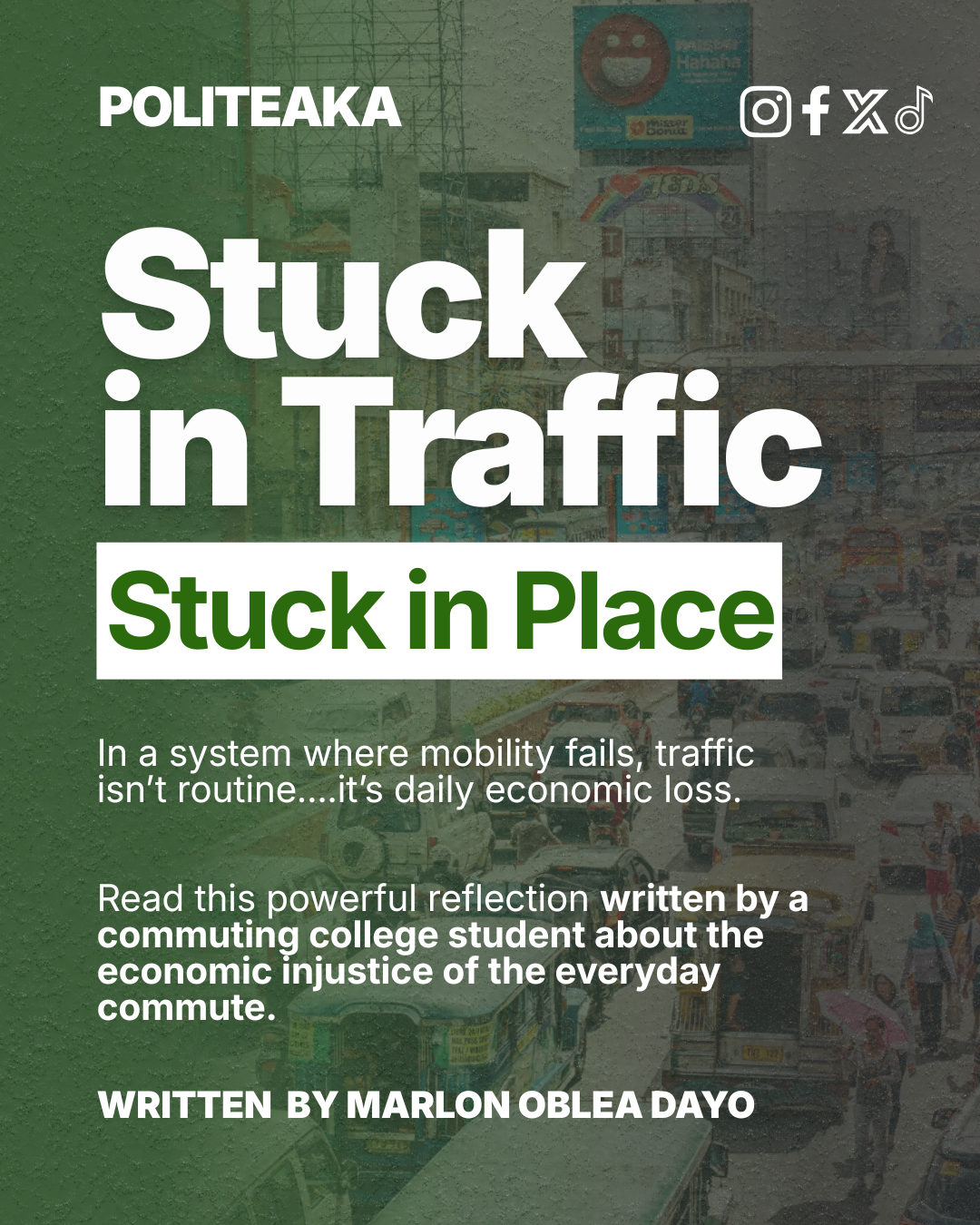
Time-in is at 8:00 AM.
It is already 8:03 AM, and I am not even near my office yet.
The jeepney IΓÇÖm riding hasnΓÇÖt moved more than a few meters in the past ten minutes. The air is thick, not just with heat, but with impatience. Engines hum endlessly, horns blare in frustration, and the conductor repeats the same line: ΓÇ£Konting usog pa.ΓÇ¥ But there is no space left to move. The stench of everyone's sweat in this vehicle mixed, but lucky me, I guess, this is an open vehicle.
This is not a rare occurrence. This is routine. By routine, I mean every single day.
Every morning, I wake up early not to get ahead, but to compensate for a system that constantly falls behind. I leave home two hours before work, budgeting extra time not for productivity, but for uncertainty. Will there be an accident? Will the traffic lights malfunction? Will the roads flood from last nightΓÇÖs rain?
Each possibility comes with a cost.
On paper, my daily wage reflects the hours I spend at work. But in reality, a significant portion of my day is unpaid time spent trapped in traffic. Two to three hours daily, multiplied over weeks and months, becomes a silent deduction from my life. Time that could have been used for rest, for family, or even for additional income is instead surrendered to the road.
Then comes the financial burden, especially with rising fuel prices, which lead to increased fares. A commute that used to cost ₱50 now reaches ₱80 or more, depending on the number of rides needed. For minimum wage earners, this is not a minor inconvenience; it is a significant portion of their daily earnings. Transportation becomes a growing expense that competes with food, rent, and other essentials. In theory, it should not be.
Beyond time and money lies another cost, one that is harder to measure.
There is exhaustion, not the kind that builds from work, but from the journey to get there. Standing for long periods, inhaling polluted air, and enduring cramped spaces take a toll on both physical and mental health. By the time the workday even begins, energy has already been spent. ΓÇ£Papasok ka palang, mukhang pauwi ka na.ΓÇ¥
There is also the social cost. Missed breakfasts with family, cancelled plans with friends, arriving home too late, and too drained to engage in meaningful conversations. Traffic does not just delay movement; it disrupts relationships and diminishes the quality of life.
Yet, this has become normalized.
Traffic congestion in Metro Manila is often framed as a macro-level issue, with statistics, infrastructure projects, and policy debates. However, on the ground, it is deeply personal. It is the employee arriving late and anxious, the student missing the first class, the driver working longer hours just to meet the same quota.
It is the quiet, everyday loss that accumulates over time.
A minute in traffic is not just a minute lost. It is a fragment of life spent waiting in a system that demands so much, yet returns so little.
And I am so exhausted.
ItΓÇÖs now 8:05 AM, and IΓÇÖm still not there.