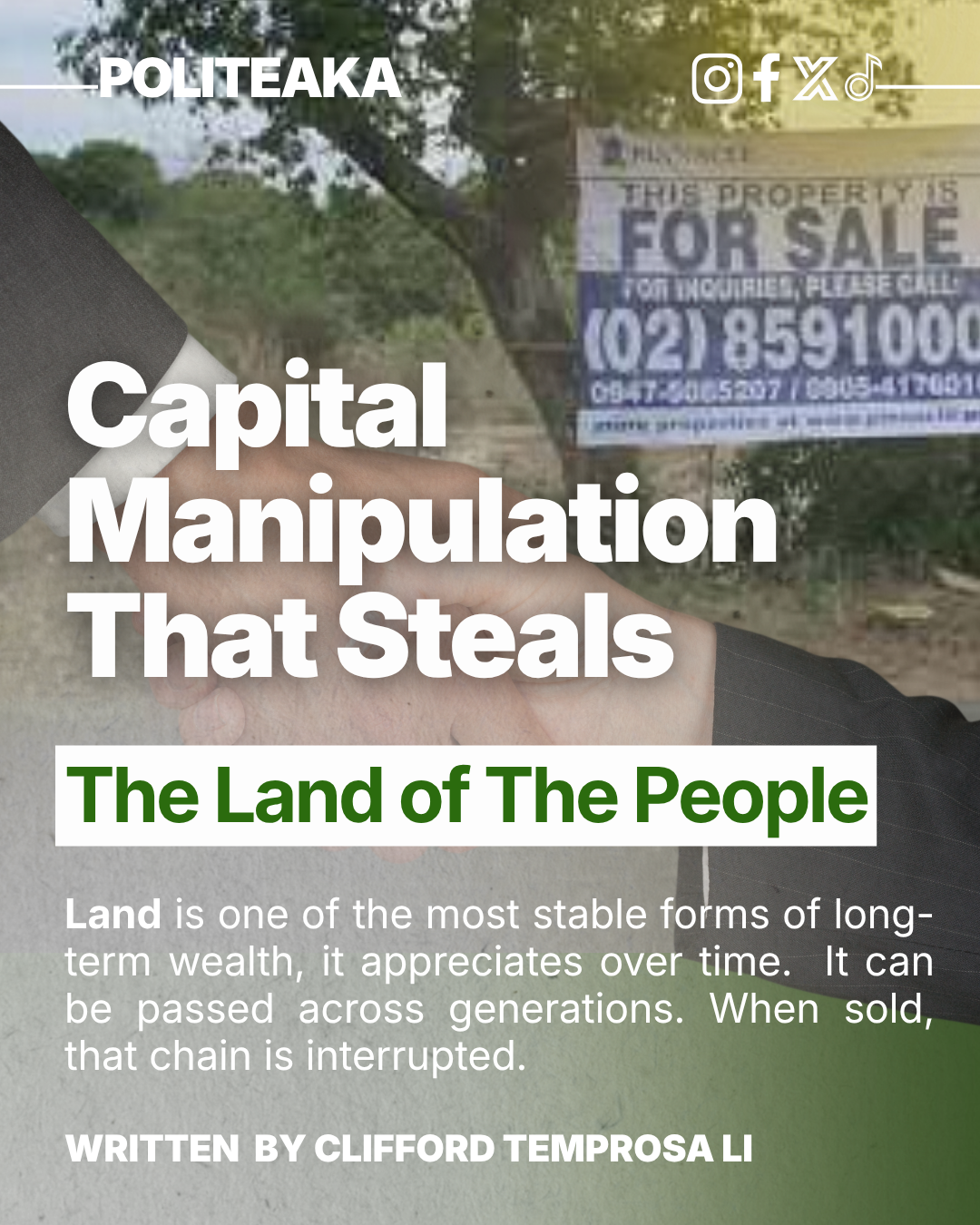
When land becomes a transaction, communities lose more than property.
The Offer That Turns Ownership Into Exit
It usually starts with a visit. A broker. A representative. Sometimes just a message.
ΓÇ£May offer po sa lupa niyo.ΓÇ¥
At first, it feels like opportunity. A price higher than expected. Cash upfront. A clean transaction.
For many families - especially those who have held land for years - the offer feels like recognition. All those years of waiting. All that land finally turning into something tangible.
I once heard someone say: ΓÇ£Sayang kung hindi ibenta. Mataas na yung offer.ΓÇ¥
It sounds practical. It sounds smart. But what comes after is rarely discussed.
A Market Rewards Exit More Than It Supports Ownership
We talk about property like itΓÇÖs about ownership. Buying. Selling. Investing. Developing.
But land is not just an asset.
It is: Security. Stability. Continuity. Identity. Our land is the inheritance of our ancestors and what preserves the wealth of the country.
And what weΓÇÖve built is not just a property market.
It is a system where:
Land is valued at its highest price. Not its longest purpose Where ownership is fragmented. And consolidation is rewarded. Where transactions are immediate. But consequences are long-term. The land changes hands. But what leaves with it is harder to recover.
Land Acquisition Manipulation
LetΓÇÖs call it what it is:
Land Acquisition Manipulation
A system where:
Individual owners are structurally incentivized to sell
Institutional and corporate buyers are positioned to acquire at scale
And long-term community stability is not built into the model
No one is explicitly forced. But the pressure is embedded.
Because the system is designed to make selling feel like the most rational….and often the only viable option.
What appears as a voluntary transaction is shaped by asymmetries in the economy, capital, information, and financial capacity.
The choice exists. But it is not neutral.
Mass Manipulation That Steals The Land of The People
This is not about isolated decisions.
It is about how incentives are structured and what those incentives consistently produce over time.
Because when the same decision is repeated across households, across communities, across regions - it stops being individual. It becomes systemic.
What looks like choice begins to reflect design. Because the conditions are not neutral.
They are shaped. Prices are set by those with capital. Liquidity is offered at moments of vulnerability. Alternatives to selling are limited or inaccessible.
So the decision narrows. Not all at once. But gradually. Until the same outcome repeats often enough to feel normal.
This is where it shifts. From individual choice to patterned behavior to predictable outcome.
It reflects a system where economic pressure is aligned with acquisition strategy.
Where those with capital move in at scale and those without it are left to respond, one decision at a time. What emerges is not just a series of transactions. It is a form of structural extraction.
Where value is transferred from individuals to institutions….not through force, but through conditions that make exit feel necessary. This is why it can feel like help.
The offer arrives when it is most needed. The price solves an immediate problem. The transaction feels like relief.
But relief in the short term does not always translate into stability in the long term. It becomes a system that converts poverty into acquisition, while presenting itself as solution.
Acquisition Is Theft That Is Engineered
1. Short-Term Value Is Prioritized Over Long-Term Stability
Corporate buyers operate with access to capital, liquidity, and long-term investment horizons.
They are able to offer prices that exceed what individual owners can reasonably generate from the land in the short term.
For families, the decision is framed as:
Immediate liquidity versus Deferred, uncertain returns
Without mechanisms that allow land to generate consistent income or access financing without sale, holding becomes economically passive. Selling becomes economically active.
This creates a structural pattern of asset conversion, where long-term, appreciating assets are exchanged for short-term liquidity. Over time, this replaces intergenerational wealth accumulation with one-time value extraction.
2. Land Consolidation Reshapes Communities
Individual land sales rarely remain isolated. They are aggregated into larger portfolios and development sites.
This leads to:
Concentration of land ownership under fewer entities
Transformation of land use toward higher-density, higher-return development
Standardization of space based on market demand rather than local use
From a systems perspective, this reflects capital-driven land consolidation.
Over time, this reshapes:
Who is able to remain in the area
How space is allocated and priced
What types of communities are sustained
Development continues to expand. But continuity becomes fragmented.
3. Families Lose Intergenerational Assets
Land is one of the most stable forms of long-term wealth.
It appreciates over time. It can be leveraged. It can be passed across generations.
When sold, that chain is interrupted. The proceeds from a sale are often:
Allocated across immediate needs
Distributed within households
Consumed over time without replacement
Unlike financial assets that are actively reinvested, lump-sum proceeds are rarely structured for long-term growth. This creates a transition from:
Asset-based security to income-dependent vulnerability
The land does not return. And the capacity it represented - financial, spatial, generational - leaves with it.
4. Pressure Is Structural, Not Personal
Families are not selling because they undervalue their land.
They are responding to structural conditions:
Rising cost of living
Income volatility
Limited access to affordable credit
Absence of asset-based financing mechanisms
In this context, land becomes the most accessible form of liquidity. So the offer becomes more than a transaction. It becomes a response to constraint.
This reflects a broader system where:
Holding assets requires financial stability and Selling assets provides immediate relief
And when stability is not supported, exit becomes the default.
5. Development Is Not Always Aligned With Local Needs
Large-scale development is driven by:
Return on investment
Market demand
Urban expansion strategies
These priorities do not always align with:
Affordability. Community retention. Cultural continuity. Local economic participation.
This creates a mismatch between:
What is built and Who it is built for
From a planning perspective, this reflects market-led development without sufficient community anchoring mechanisms. Spaces are produced efficiently. But not always equitably.
What could have been community centers, local businesses, and community spaces - become condominium developments, tourism traps, towns or villages made for the wealthy.
The End of Local Ownership
Over time, the pattern becomes structurally visible. Individual land exits do not remain isolated.
They accumulate. As transactions repeat across households, land begins to shift from distributed ownership to concentrated control.
Ownership consolidates under fewer entities with greater access to capital, longer investment horizons, and the ability to aggregate parcels at scale.
Communities do not disappear all at once. They are gradually reconfigured.
Households sell and relocate outward. Neighborhood composition shifts over time. Access to land becomes increasingly constrained for those without capital. This process is not confined to a single geography.
It is occurring across:
Urban centers
Peri-urban expansion zones
Rural areas transitioning into development corridors
From a systems perspective, this reflects progressive land consolidation paired with capital-driven revaluation.
As land transitions from individual ownership to institutional portfolios, several shifts occur simultaneously:
Development intensity increases as land is optimized for return
Local ownership declines as entry barriers rise
Land prices adjust upward based on future projected valueΓÇönot existing use
This creates price displacement effects, where land is no longer valued based on its current community function, but on its anticipated yield within larger development models.
Over time, this produces a structural condition where:
Re-entry becomes economically unviable for original residents
Ownership becomes inaccessible without significant capital
Communities become transitional rather than stable
Development continues to expand. But the ability to remain within that development does not expand at the same pace. Because once land is consolidated, repositioned, and repriced - it is no longer operating within the same market conditions that allowed initial ownership. It has been absorbed into a different system of valuation. And within that system, returning is not simply difficult. For most, it is no longer possible.
Combatting Land Acquisition and Protecting The PeopleΓÇÖs Wealth
If land is going to remain a source of stability, the system cannot treat ownership as a passive condition. It has to actively support people in keeping it. Right now, the structure favors conversion - turning land into cash - over retention. Rebalancing that requires building systems that make holding land not just possible, but economically viable.
1. Strengthen Incentives for Asset Retention
At present, the system places very little economic value on long-term ownership. Land is easiest to monetize at the point of sale, not while it is held.
This creates a structural bias toward exit. To shift this, policy and financial systems need to reward retention, not just transaction.
This can take the form of tax structures that favor long-term ownership, as well as support for alternative income-generating uses such as leasing, joint-use agreements, or small-scale development partnerships that do not require full transfer of ownership.
In effect, land must be repositioned as a productive, income-generating asset not just a dormant one that becomes valuable only when sold. When holding land creates ongoing economic value, the pressure to sell decreases.
2. Expand Access to Asset-Based Financing
One of the primary drivers of land sale is liquidity constraint.
Families often do not sell because they want to exit ownership, but because they need access to capital. In the absence of accessible credit systems, land becomes the only available source of liquidity.
Expanding asset-based financing mechanisms changes this dynamic. This includes low-interest lending models, land-backed credit systems, and flexible financing structures that allow owners to leverage their assets without transferring ownership.
These systems must be designed to be accessible, with simplified requirements and protections against predatory terms. When land can be used as collateral for stability - rather than liquidated for survival - the need for forced sale is reduced.
3. Support Community Ownership and Collective Structures
Individual ownership, while valuable, can also create fragmentation and vulnerability - especially when decisions are made under financial pressure.
Collective ownership models introduce a different structure. Mechanisms such as cooperatives, community land trusts, and shared ownership entities allow land to be:
Held collectively
Managed with long-term intention
Developed without full transfer to external actors
From a systems perspective, this shifts land from an individually vulnerable asset to a collectively protected one. It also creates a buffer against speculative acquisition and consolidation, while preserving local control over land use and development.
4. Regulate Large-Scale Land Acquisition and Consolidation
Market-driven land acquisition, when left unregulated, tends toward consolidation.
Entities with greater capital are able to acquire land incrementally, eventually controlling large portions of a given area. This creates market concentration effects, where pricing power, land use decisions, and development direction become centralized.
Policy frameworks can intervene by:
Establishing thresholds or review processes for large-scale acquisitions
Requiring community impact assessments prior to consolidation
Embedding safeguards that prioritize equitable development outcomes
The goal is not to stop development. It is to ensure that development does not systematically displace ownership at scale.
5. Align Development With Local Continuity
Development is often evaluated based on output - units built, land utilized, capital deployed.
But long-term sustainability depends on whether development maintains continuity for the people already there. This requires shifting from purely market-driven planning toward community-anchored development frameworks.
This includes integrating affordability requirements, protecting existing residents from displacement, and ensuring that economic benefits - such as jobs and services - are accessible to local populations.
It also requires designing spaces that reflect how communities actually live, rather than optimizing solely for return. When development is aligned with continuity, growth does not require displacement.
A System That Moves Land Out of PeopleΓÇÖs Hands
This is not simply about whether people should sell. It is about what happens when selling becomes the default outcome within the system.
Because decisions do not exist in isolation. They are shaped by conditions that repeatΓÇöacross households, across communities, across time.
Limited access to capital. Rising cost of living. Unstable income. Stronger, more immediate incentives to exit ownership.
When these conditions are consistently present, they begin to structure behavior. And when the same decision - selling land - is made repeatedly under similar conditions, it stops being individual. It becomes a standard industry of practice.
Ownership does not disappear suddenly. It shifts gradually. One property at a time. One family at a time. One transaction at a time.
Until a broader pattern becomes visible. Assets that were once held long-term begin to circulate more quickly. Ownership becomes shorter in duration. Control over land begins to consolidate.
From a systems perspective, this reflects a transition from stable ownership models to high-turnover asset systems, where land is no longer anchored to people but to capital flow.
Over time, several structural shifts take place:
Assets become temporary - held only until the next transaction
Ownership becomes transitional - less tied to long-term use and continuity
Communities become fluid - less anchored, more susceptible to displacement
Land is no longer primarily a place to build life. It becomes a vehicle for value transfer. Something that passes through hands - rather than something that stays within them. And when this process scales, the system changes in function. It is no longer simply facilitating transactions between buyers and sellers. It is redistributing ownership.
Stop Framing Exit as Opportunity
Selling land is often framed as success.
A good deal. A smart move. A moment of opportunity. And sometimes, it is.
But when selling becomes widespread ΓÇô when it becomes the most common outcome across different communities - it begins to reflect something deeper than individual success.
The conditions are clear:
Holding land is financially difficult.
Selling land is economically straightforward.
Long-term stability is not structurally supported.
So the decision is shaped long before the offer arrives. The offer simply confirms it.
That is why the question cannot stop at: ΓÇ£Maganda ba ang offer?ΓÇ¥
Because a good offer does not exist in isolation. It exists within a system that has already narrowed the range of options.
The more important question is: Bakit parang ito lang ang option?
And that question points directly to what needs to change. Because if the system continues to make exit the easiest path, then exit will continue to scale.
Make Ownership Sustainable and Not Temporary
If we want ownership to remain possible,not just temporary,then the response cannot stay at the level of individual decisions.
That means:
Building financial systems that allow families to access capital without selling
Creating policy incentives that reward long-term ownership
Regulating acquisition patterns that concentrate land at scale
Supporting community-led ownership and development models
And just as importantly: Reframing how we talk about land. Not just as something to sell when the price is right but as something that can generate value, security, and continuity over time. Because until those alternatives are visible, accessible, and viable….selling will continue to feel like the only rational choice.
The land changes hands. The buildings rise. The city expands.
Growth continues.
But unless the system is redesigned to support people in holding what they have to make ownership sustainable, not temporary - families will continue to sell, ownership will continue to concentrate, and communities will continue to shift outward….until the places people once built their lives in become places they can no longer return to.