"Who Gets to Live Well and Who Is Asked to Carry the Cost"
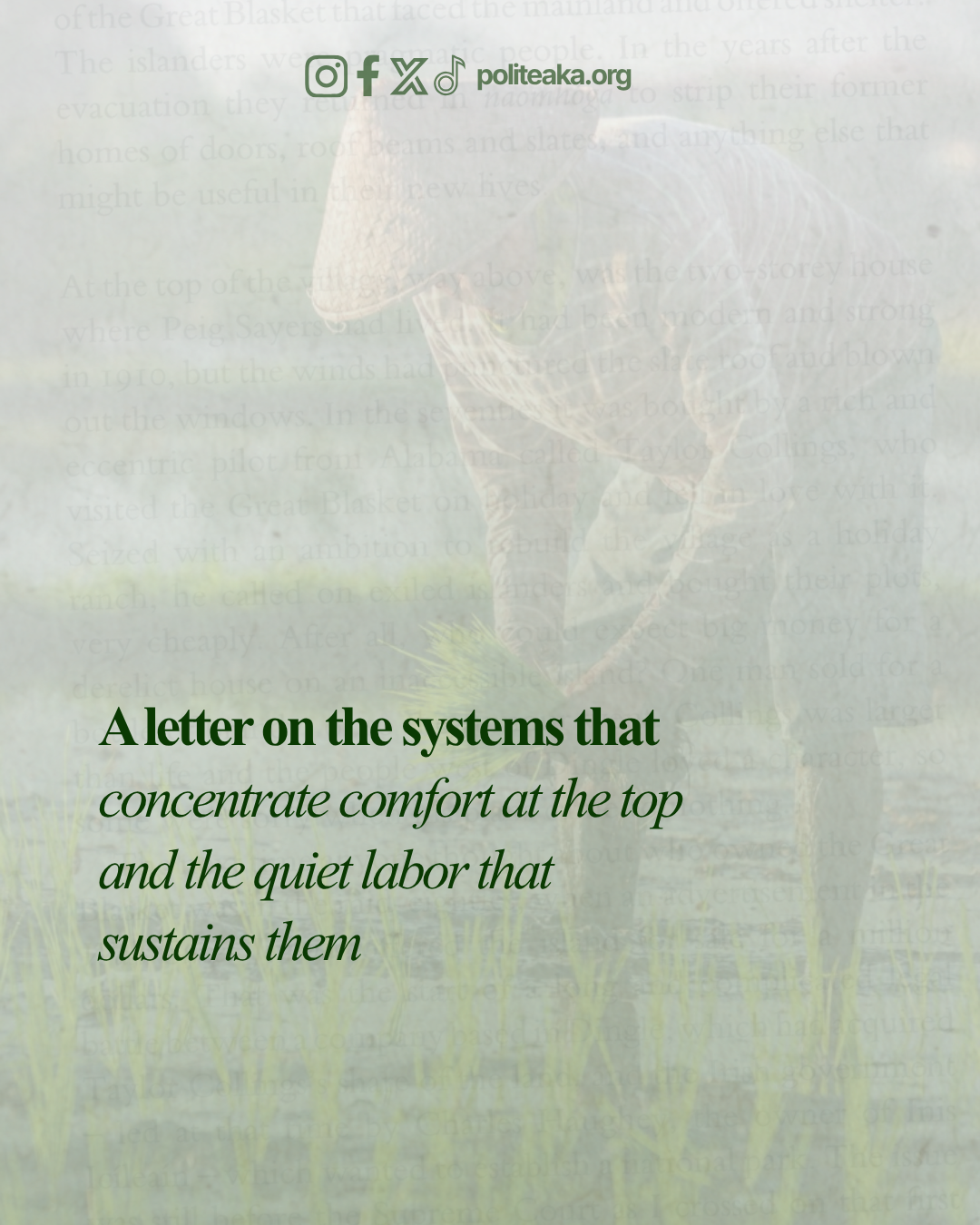
A letter on the systems that concentrate comfort at the top and the quiet labor that sustains them
Look closely at how life is arranged.
Who eats without thinking and who measures every portion. Who chooses where to live and who adjusts to where they can afford to stay. Who wears what they want and who makes those choices possible for others.
These are not accidents. They are outcomes.
They are shaped by systems that decide….quietly, consistently…. who gets comfort, who gets access, and who is asked to carry the weight of both.
There are lives that move with ease. Food arrives without question. Space is chosen, not negotiated. Time belongs to the person living it.
And there are lives that move differently. Meals are calculated. Rent is adjusted around income that does not stretch. Time is spent working….often for someone else’s stability.
This is inequity and inequality.
It is a system where value flows upward while effort remains below. Where labor sustains comfort that is not equally shared. Where the work of many becomes the ease of a few.
People begin to accept that this is how life is meant to be.
That some will always have more choice. That others will always have less. That comfort will always depend on someone else carrying its cost.
But this is not a natural order. It is a maintained one.
It is maintained in how we work. In how wages are set and what they are expected to cover. In how long people are asked to give their time and how little they are asked in return.
It is maintained in how we consume. In what we demand to be cheap and who absorbs the cost of keeping it that way.
It is maintained in how we move through space. In who is welcomed, and who is tolerated, and who is pushed further out each year.
This is how systems sustain themselves. Not only through policy but through everyday behavior that reinforces them.
So do not think this is distant. It is not. Then stop moving through it as if it cannot be changed.
Every time we accept conditions that exploit time, labor, or dignity….we participate in their continuation. Every time we choose convenience without asking what makes it possible….we reinforce the structure that provides it. And every time we adjust quietly, the system becomes stronger.
So this is where the call begins.
When something is cheap, ask why. Ask who made it possible for it to cost so little. Ask whose time, labor, or dignity absorbed the difference.
When something is convenient, pause. Do not move through it automatically. Understand what allows it to be easy for you and whether it is equally easy for others.
When something feels unequal,do not move past it quietly. Do not explain it away. Do not justify it as normal. Do not adjust to it as if it cannot be changed.
Do not look away. Do not adjust. Do not explain it away.
Ask where things come from. Ask who pays for what appears affordable. Ask who is left out of decisions that shape how others live.
Slow down the moment.
Because systems like this depend on speed. On people moving through them without asking. Without pausing. Without connecting what they see to how it is sustained.
Interrupt that.
Insist on fairness where it is uneven. Insist on dignity where it is negotiated. Insist on systems that return value to the people who create it.
Not as an act of anger but as an act of clarity. Because dignity is not something that should be reserved for a few. And stability should not depend on someone else living without it.
You will feel the weight of this. It will not always be convenient. It will not always be rewarded.
But it will do something systems cannot easily absorb.
It will draw a line. It will introduce friction. It will make visible what was designed to remain quiet.
And when that is done consistently systems begin to respond. You are already part of this system. The only question is how you will move within it….whether you will continue what exists, or begin to interrupt it.
Kung ang kaginhawaan ng iilan ay nakatayo sa hirap ng nakararami, tungkulin nating baguhin ang kaayusan.
The question is no longer whether inequality exists. The question is:
will you continue to live within it as if it is fixed or begin, in the life you live every day, to refuse the part of it that depends on you.
Look closely at how life is arranged.
Who eats without thinking and who measures every portion. Who chooses where to live and who adjusts to where they can afford to stay. Who wears what they want and who makes those choices possible for others.
These are not accidents. They are outcomes.
They are shaped by systems that decide….quietly, consistently…. who gets comfort, who gets access, and who is asked to carry the weight of both.
There are lives that move with ease. Food arrives without question. Space is chosen, not negotiated. Time belongs to the person living it.
And there are lives that move differently. Meals are calculated. Rent is adjusted around income that does not stretch. Time is spent working….often for someone else’s stability.
This is inequity and inequality.
It is a system where value flows upward while effort remains below. Where labor sustains comfort that is not equally shared. Where the work of many becomes the ease of a few.
People begin to accept that this is how life is meant to be.
That some will always have more choice. That others will always have less. That comfort will always depend on someone else carrying its cost.
But this is not a natural order. It is a maintained one.
It is maintained in how we work. In how wages are set and what they are expected to cover. In how long people are asked to give their time and how little they are asked in return.
It is maintained in how we consume. In what we demand to be cheap and who absorbs the cost of keeping it that way.
It is maintained in how we move through space. In who is welcomed, and who is tolerated, and who is pushed further out each year.
This is how systems sustain themselves. Not only through policy but through everyday behavior that reinforces them.
So do not think this is distant. It is not. Then stop moving through it as if it cannot be changed.
Every time we accept conditions that exploit time, labor, or dignity….we participate in their continuation. Every time we choose convenience without asking what makes it possible….we reinforce the structure that provides it. And every time we adjust quietly, the system becomes stronger.
So this is where the call begins.
When something is cheap, ask why. Ask who made it possible for it to cost so little. Ask whose time, labor, or dignity absorbed the difference.
When something is convenient, pause. Do not move through it automatically. Understand what allows it to be easy for you and whether it is equally easy for others.
When something feels unequal,do not move past it quietly. Do not explain it away. Do not justify it as normal. Do not adjust to it as if it cannot be changed.
Do not look away. Do not adjust. Do not explain it away.
Ask where things come from. Ask who pays for what appears affordable. Ask who is left out of decisions that shape how others live.
Slow down the moment.
Because systems like this depend on speed. On people moving through them without asking. Without pausing. Without connecting what they see to how it is sustained.
Interrupt that.
Insist on fairness where it is uneven. Insist on dignity where it is negotiated. Insist on systems that return value to the people who create it.
Not as an act of anger but as an act of clarity. Because dignity is not something that should be reserved for a few. And stability should not depend on someone else living without it.
You will feel the weight of this. It will not always be convenient. It will not always be rewarded.
But it will do something systems cannot easily absorb.
It will draw a line. It will introduce friction. It will make visible what was designed to remain quiet.
And when that is done consistently systems begin to respond. You are already part of this system. The only question is how you will move within it….whether you will continue what exists, or begin to interrupt it.
Kung ang kaginhawaan ng iilan ay nakatayo sa hirap ng nakararami, tungkulin nating baguhin ang kaayusan.
The question is no longer whether inequality exists. The question is:
will you continue to live within it as if it is fixed or begin, in the life you live every day, to refuse the part of it that depends on you.